

40,000 lb Crane Scale Buying Guide: 10 lb Resolution, Battery, Remote & Capacity Planning
- pete8781
- 4 hours ago
- 3 min read
For help choosing the right capacity, call MNM Scales at (832) 290-3120 or email mnmscales@yahoo.com.
Buying a 40,000 lb crane scale is not just a capacity decision. Buyers should evaluate normal load range, 10 lb display resolution, the scale's own 90 kg weight, headroom, rechargeable-power logistics, remote operation, temperature limits, calibration access and whether a certified legal-for-trade instrument is required.
1. Start with Normal Load, Not Maximum Marketing Capacity
Estimate the loads you actually expect, including containers, lifting attachments and credible process variation. A 40,000 lb capacity makes sense when routine or occasional loads genuinely require that range. If almost everything is below 5,000 or 10,000 lb, a lower-capacity scale may offer easier handling and finer practical resolution.
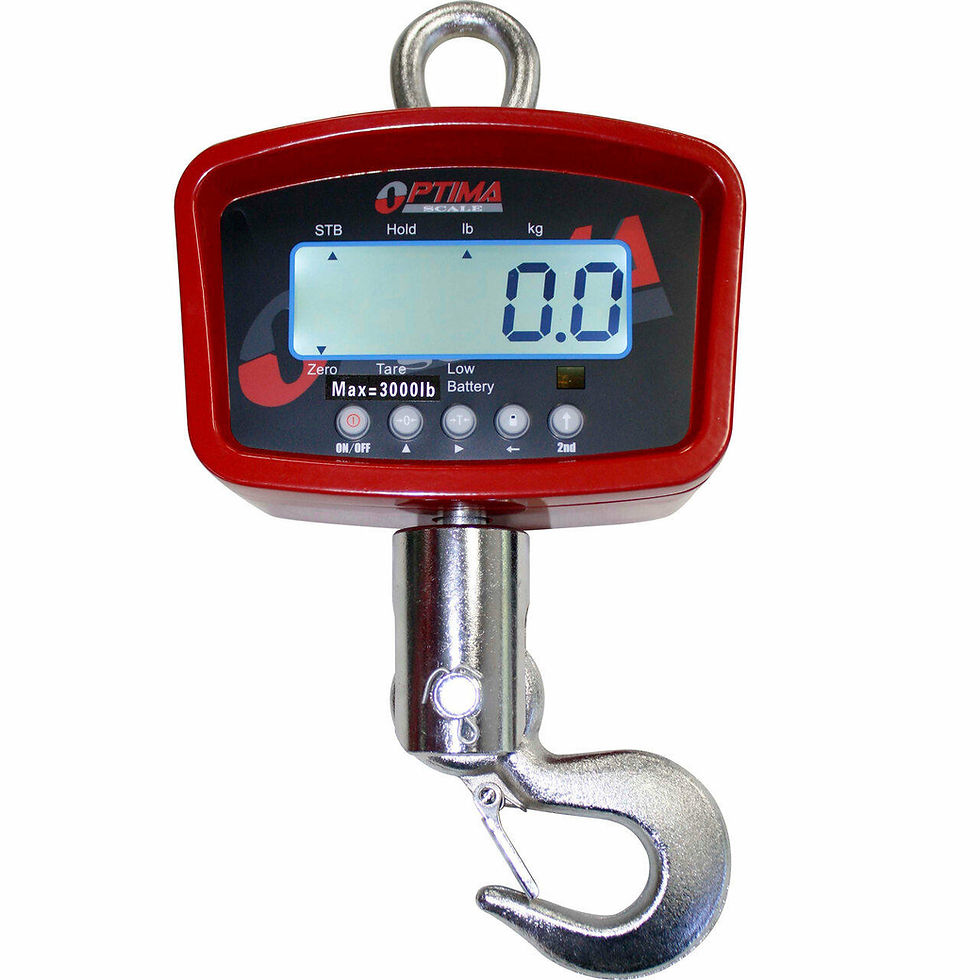
2. Decide Whether 10 lb Increments Are Fine Enough
The IDS-808-40K-1 is listed at 40,000 lb × 10 lb, or 4,000 displayed divisions. For steel bundles, machinery, castings and freight weighing, a 10 lb step may be entirely appropriate. If the process needs to distinguish a 2 or 5 lb change, a 40,000 lb range is probably not the right measurement tool even if it can physically carry the load.
3. Account for the Scale's 90 kg Self-Weight
The listed 90 kg instrument weight is roughly 198 lb. That affects crane headroom, storage, handling equipment, installation labor and the total suspended load. A heavy crane scale may stay installed in one bay rather than moving between departments every day, so consider where it will live before purchasing.
4. Plan Battery Charging and Remote Use
MNM lists a 6 V / 3.2 Ah rechargeable battery, AC 110 V charger and included remote. Confirm the facility has a defined charging routine and that operators understand remote functions before production use. If the scale will be used across multiple shifts, battery management is part of uptime planning, not an afterthought.
5. Check the Temperature Range Against the Work Area
The listing gives a surrounding range of -5°F to 140°F and an operating range of 15°F to 105°F. The operating range is the more important planning figure for active weighing. Foundry, outdoor winter and hot-process environments can exceed it, so determine the temperature at the instrument rather than only the building's thermostat setting.
6. Ask About Calibration and Certification Before You Need Them
A 40,000 lb scale requires high-capacity calibration resources. Decide how often it must be calibrated, whether the facility can provide reference loads and whether an outside service provider will be needed. The MNM listing does not state NTEP approval, so applications that sell, bill or certify weight under legal-for-trade rules should confirm the required certification before purchase.
7. Do Not Treat “125% F.S.” as Extra Working Capacity
The page's maximum-safe-load and overload lines are ambiguous when read together. Buy capacity around your actual workload and operate within the 40,000 lb rated range unless authoritative product documentation says otherwise. A safety margin belongs in the overall crane and rigging plan; it should not be created by deliberately using an overload number as normal weighing capacity.
Buyer Checklist
Confirm normal and maximum expected load; required display resolution; crane/hoist capacity including scale self-weight; available headroom; compatible rated attachment hardware; operating temperature; charging location; remote-control needs; calibration plan; and certification requirements. That checklist usually answers whether a 40,000 lb crane scale is the correct tool before price becomes the deciding factor.
FAQ
How many display divisions does 40,000 × 10 provide? 4,000. Why does self-weight matter? The crane system carries the scale as well as the payload. Does it include a remote? Yes. What power does it use? A listed 6 V / 3.2 Ah rechargeable battery with AC 110 V charger. Is it suitable below 15°F? The listed operating range starts at 15°F, so colder operation should be confirmed before use. Is “Accuracy III” the same as NTEP? The listing does not state NTEP certification, so do not assume legal-for-trade approval from that wording alone.
Comments