

How to Calibrate & Verify the IDS-808-40K-1 40,000 lb Crane Scale
- pete8781
- 2 days ago
- 3 min read
For calibration or service questions, call MNM Scales at (832) 290-3120 or email mnmscales@yahoo.com.
Calibrating a 40,000 lb crane scale is a high-capacity metrology task, not simply a keypad exercise. The IDS-808-40K-1 product page gives capacity, display and power specifications but does not publish a calibration-menu sequence, so the exact service procedure should come from the delivered scale's manual while the verification principles below remain universal.
Start with Inspection and a Stable Zero
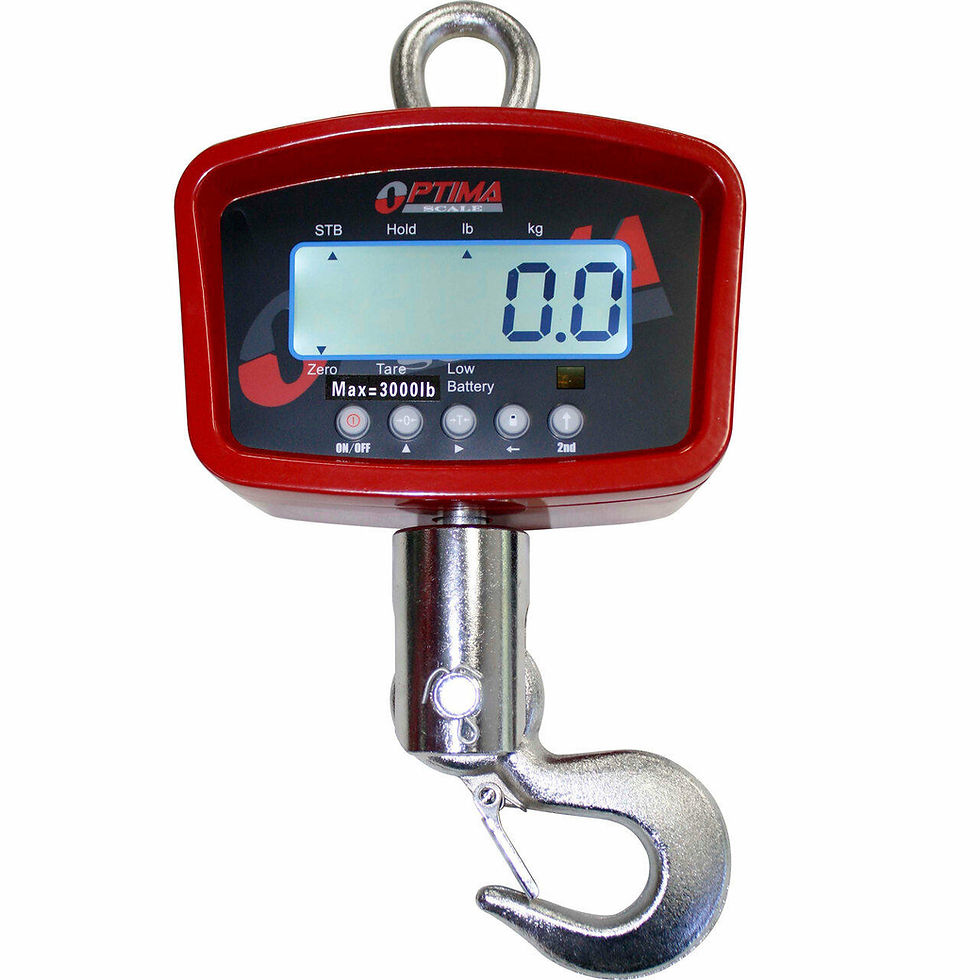
Inspect the scale body, display, attachment points, remote and battery condition before applying a reference. With no suspended test load, allow the scale to stabilize and confirm zero. The scale itself is listed at 90 kg, so zero must account for the instrument's internal measurement design rather than treating the scale body as an external test load.
Use a Reference Method Appropriate to 40,000 lb Capacity
High-capacity crane scales may be verified with certified test weights, a calibrated force system, an appropriate proving setup or another traceable method selected by the calibration provider. Whatever method is used, the supporting crane/fixture must be designed for the load. Do not build a makeshift suspended calibration arrangement simply to reach a high test point.
Check Several Points, Not Just One
A useful verification includes low, middle and upper working-range points where practical, plus return to zero. Repeat at least one point to assess repeatability. Record the reference value, crane-scale indication, error and whether the load was increasing or decreasing. A single successful span point can miss mechanical hysteresis or nonlinear error.
Control Motion During Verification
Suspended loads can swing, rotate and oscillate. That motion changes the instantaneous force seen by the scale and can make a stable weight appear noisy. Allow the reference load to settle before recording a static point and follow the scale's hold/filter procedure from its manual. Avoid using shock or a sudden pickup as a calibration method.
Battery and Display Checks Belong in the Procedure
The IDS-808-40K-1 uses a 6 V / 3.2 Ah rechargeable battery and includes an AC 110 V charger. Verify charging behavior, low-battery indications and display readability as part of service. A marginal battery may not directly create a calibration error, but unreliable power can interrupt weighing and should be corrected before returning the scale to service.
When Recalibration Is Appropriate
Recalibrate or professionally verify after repair, sensor/display service, an overload or shock event, failed known-load checks, unexplained drift, or at the interval required by the facility's quality program. Because the product listing does not give a service-menu sequence, do not copy instructions from an unrelated crane-scale model that merely looks similar.
Understand the 125% Full-Scale Line Conservatively
MNM lists “Maximum safe load: 125% F.S.” but also an “Overload: 100% F.S.” line. Since the meaning is ambiguous, calibration planning should remain at or below the rated 40,000 lb capacity unless the exact manufacturer documentation and qualified engineering procedure explicitly state otherwise. Never use an overload specification as a target calibration load without authoritative instructions.
FAQ
Can I calibrate it with one small test weight? A small reference may verify only a small part of range and may not support high-capacity accuracy claims. Do I need to test at 40,000 lb? The calibration plan should cover the actual working range with appropriate uncertainty; a qualified provider can choose points. Why does the reading move while the load swings? Dynamic acceleration changes the force seen by the scale. Is there a published keypad sequence on the MNM page? No. Should I copy another crane-scale manual? No; use the exact delivered model's procedure. When should I re-verify? After service, overload/impact, failed checks, relocation if required by procedure, or at scheduled calibration intervals.


Comments