

A&D EJ-123 for Education, Jewelry, Formulation & Small Parts
- pete8781
- Jul 31
- 3 min read
Need more details or help choosing the correct item? Call MNM Scales at (832) 290-3120 or email mnmscales@yahoo.com.
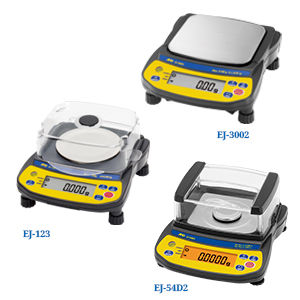
A&D EJ-123 applications are strongest where a compact 120 g × 0.001 g balance can replace rougher 0.01 g equipment without requiring the cost or complexity of a full analytical balance. Its portability, breeze break, stainless pan and advanced modes make it suitable for teaching laboratories, jewelry benches, formulation work, small-component inspection and carefully controlled inventory tasks.
Education and teaching laboratories
A&D specifically highlights the EJ-123/303 for education. The combination of 1 mg readability and a visible, easy-to-operate interface lets students observe small mass changes without the more demanding workflow of a 0.1 mg analytical balance. Typical classroom work includes solution preparation, density exercises, percentage composition, repeated-measurement demonstrations and statistics labs. The clear breeze break helps students see why air movement affects small-mass measurements, making the instrument useful both as a tool and as a teaching example.
Jewelry and small precious-metal components
For non-trade process work, the EJ-123 can help sort, compare and document small jewelry components, findings, stones and precious-metal samples. The 0.001 g division gives much finer process visibility than a typical 0.01 g bench scale. Because commercial buying or selling by weight can be subject to legal-for-trade requirements, the EJ-123 should not automatically be assumed to be the correct commercial transaction scale. Use it for process control, design, sorting and internal quality work unless your local legal requirements specifically permit the configuration.
Formulation, pigments and small-batch ingredients
The balance is well suited to small-batch formulation when ingredients are measured in tens of grams or less and 1 mg display resolution is useful. Examples include pigments, dyes, catalyst components, laboratory additives, resin modifiers, adhesives, powders and experimental blends. Percent mode can compare a measured addition with a stored reference. For best repeatability, use containers that fit comfortably inside the breeze break and avoid warm or electrostatically charged samples.
Small-part counting and kitting
ACAI counting is a strong fit for screws, pins, terminals, electronic components, washers, clips and other small parts that are reasonably uniform. Begin with an appropriate sample quantity, store the unit weight, then add more pieces so ACAI can improve the calculated average. The published 120,000-piece maximum is a display capability, not a guarantee that every ultra-light part can be counted accurately. The key question is whether each individual part has enough mass and consistency relative to the 0.001 g division.
Portable workstations and field-style checks
Four-AA battery operation lets the EJ-123 move between classrooms, benches and inspection stations without requiring a permanent outlet. Portability does not eliminate environmental requirements: a rigid level surface, protected location and stable temperature are still important. A portable precision balance should be transported carefully and verified after relocation because even a small change in level or environment can change milligram readings.
Density and materials exercises
A&D offers the EJ-13 density determination kit specifically for the EJ-123/303. This allows automatic density calculation workflows when used correctly with the balance. In education, it can support Archimedes-principle demonstrations. In small materials labs, it can support comparative checks of samples where the required uncertainty is compatible with a 1 mg balance. The optional under-pan or density accessories should be installed and used according to A&D documentation rather than improvised fixtures that can side-load the sensor.
Workflow tips for better results
Keep the pan and breeze break clean, center the load, allow samples to reach room temperature, and avoid touching calibration weights with bare hands. Verify zero before a batch and periodically check with a known mass. If results suddenly become noisy, look first for drafts, vibration, static, an unlevel bench or material touching the breeze break. Those causes are more common than a failed weighing sensor.
FAQ
Is the EJ-123 suitable for school labs?
Yes. A&D specifically presents the EJ-123/303 as useful educational balances, and the 1 mg readability is fine enough for many chemistry and physics exercises.
Can it weigh jewelry?
It can weigh small jewelry components for process work, but commercial transactions by weight may require a specifically approved legal-for-trade scale.
Is 120 g enough capacity for formulation?
For small experimental batches, often yes. Remember that container tare consumes part of the available capacity, so choose vessels accordingly.
Can the EJ-123 count electronic parts?
Yes when unit weights are sufficiently large and consistent. ACAI helps improve the stored average as more parts are added.
Does it support density measurement?
Yes. A&D offers the EJ-13 density determination kit for the EJ-123/303.
Should it be recalibrated every time it moves?
At minimum, verify it with a known mass after relocation. A&D recommends calibration when first used, after moving and when environmental conditions change.
Comments