

How to Calibrate & Verify the A&D EJ-123 Milligram Balance
- pete8781
- Jul 31
- 3 min read
Need more details or help choosing the correct item? Call MNM Scales at (832) 290-3120 or email mnmscales@yahoo.com.
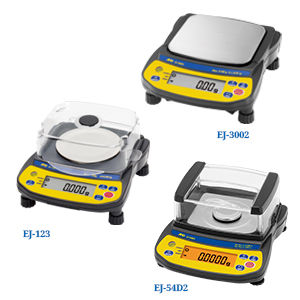
A&D EJ-123 calibration is an external-weight procedure, and the best results come from treating calibration as the final step after setup and environmental problems have been ruled out. The EJ-123 reads to 0.001 g, so level, drafts, vibration, temperature and static can easily create apparent calibration errors if the balance is not stabilized first.
Before calibration: stabilize the environment
Set the EJ-123 on a rigid bench, level it with the feet and bubble, install the breeze break and keep the pan empty. Avoid direct HVAC airflow, doors, fans, vibrating equipment and sunlight. If the balance has just been moved from a different temperature, let it reach room conditions before deciding that it is out of calibration. Clean the pan and confirm nothing touches the pan support or breeze-break walls.
Use the correct calibration mass
A&D’s EJ manual instructs users to calibrate with an external mass greater than two-thirds of the balance capacity. For a 120 g EJ-123, that means a mass above 80 g. MNM lists 100 g as the factory calibration-weight setting, making 100 g a practical target when an appropriate traceable or known calibration weight is available. The quality of the weight directly affects calibration quality, so do not substitute random household objects or nominal masses of unknown accuracy.
EJ-123 external calibration sequence
A&D’s manual describes using the calibration switch to enter CAL mode. With nothing on the pan, the balance measures the zero point. The user can select or confirm the displayed calibration-weight value using the SAMPLE, RE-ZERO and PRINT keys, then places the matching external weight on the pan and presses PRINT to store the span point. When calibration finishes, remove the weight and allow the balance to return to weighing mode. Avoid touching the table or draft shield while the zero and span measurements are being captured.
Verification should come before unnecessary recalibration
If the balance has been performing normally, verify it before changing calibration. Zero the balance, place a known weight near the center of the pan and wait for stability. Repeat the placement several times. A stable, repeatable offset suggests span calibration may need attention; an unstable result suggests environment, static, vibration or mechanical interference. A single odd reading is not enough evidence to recalibrate a 1 mg balance.
Repeatability and multi-point checks
After calibration, perform repeatability checks with the same mass and then, if your quality process requires it, check additional points through the working range. The goal is to confirm not only that one calibration point reads correctly but that routine sample weights behave consistently. If only very small loads are used, include a test near that working range. Keep in mind that the published display division is not the same thing as guaranteed measurement uncertainty under every environment.
Troubleshooting unstable or drifting readings
Drafts are a frequent cause of slow movement on a milligram display; keep the breeze break closed while reading. Static from plastics, powders, gloves and low humidity can create persistent offsets. Warm samples create convection currents. A soft or vibrating bench can prevent stability. Low battery voltage can also cause unreliable operation. If the same known mass produces different results each time, solve those problems before performing another span calibration.
When should the EJ-123 be calibrated?
A&D recommends calibration when the balance is first used, after it has been moved, when environmental conditions have changed and at regular intervals. The appropriate regular interval depends on the consequences of error, how often the balance is used, how often it moves and the requirements of your quality system. A verification log can help establish whether the balance actually drifts between scheduled calibrations.
FAQ
What calibration weight does the EJ-123 use?
MNM lists 100 g as the factory setting. A&D’s procedure permits an appropriate external weight and advises a mass greater than two-thirds of capacity.
Does calibration require an internal motorized weight?
No. The EJ-123 is calibrated with an external weight.
Why does the balance drift after calibration?
Common causes include drafts, static, temperature gradients, vibration, an unlevel surface or sample/pan interference. Calibration cannot compensate for a changing environment.
Should I touch calibration weights with bare hands?
Avoid it when accuracy matters. Oils, moisture and heat from fingers can alter or destabilize small calibration masses.
Can I verify with a weight smaller than 100 g?
Yes for verification at a working point, provided the weight is suitable and known. Calibration itself should follow the manufacturer’s procedure and permitted calibration-mass range.
Does moving the balance require checking it again?
Yes. Re-level it and verify with a known mass after relocation; A&D specifically lists moving the balance as a reason to calibrate.
Comments