

A&D SJ-15KWP 33 lb / 15 kg IP67 NTEP Washdown Scale Guide
- pete8781
- Jul 31
- 5 min read
Need more details or help choosing the correct item? Call MNM Scales at (832) 290-3120 or email mnmscales@yahoo.com.
The A&D SJ-15KWP washdown scale is a 33 lb / 15 kg IP67 food and checkweighing scale that combines unusually fine process resolution with a separate fixed Class III legal-for-trade configuration. The exact NTEP status is established by CoC 18-131: SJ-15KWP is certified at 15 kg × 0.005 kg, 15,000 g × 5 g, 33 lb × 0.01 lb and 520 oz × 0.2 oz, with nmax 3300. The much finer 0.5 g / 0.001 lb display advertised for high-resolution work is not the NTEP trade interval. A&D’s current U.S. page describes SJ-WP as a dual-mode legal-for-trade and high-resolution platform, while the Bluetooth SJ-WP-BT versions are separate high-resolution communications models rather than the trade configuration.
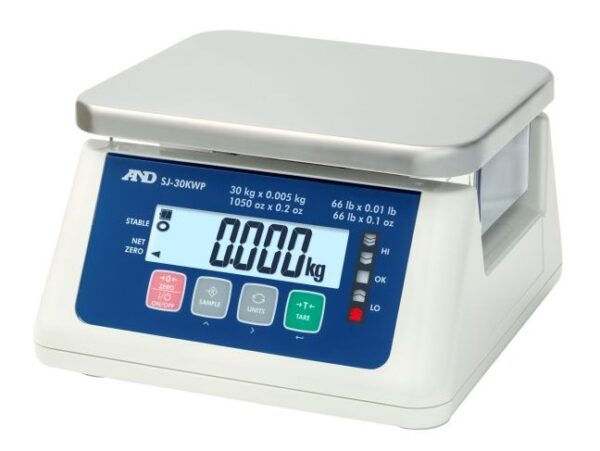
Exact SJ-15KWP legal-for-trade configuration
NTEP Certificate of Conformance 18-131 identifies the SJ-WP Series as Class III. For SJ-15KWP, the table lists 15 kg × 0.005 kg, 15,000 g × 5 g, 33 lb × 0.01 lb and 520 oz × 0.2 oz. The certificate also lists nmax 3300, a -10 °C to 40 °C operating range, DC power from six D-cell batteries, semi-automatic zero and tare, automatic zero tracking, a level indicator, and a Category 1 physical seal protecting calibration access. Those are the values a buyer, service company or inspector should use for the certified commercial mode.
High-resolution mode is different from NTEP trade mode
The standard SJ-WP platform also supports selectable high-resolution display settings for internal process work. For SJ-15KWP the high-resolution family settings include 15 kg with minimum displays as fine as 0.0005 kg (0.5 g) and 33 lb with minimum displays as fine as 0.001 lb. A&D’s manual explains that ordinary high-resolution SJ-WP units can select among several display-resolution ratios, while legal-for-trade models use a fixed resolution and do not allow the normal resolution-selection function. This is why a product page can truthfully advertise 0.5 g process readability and still have a 5 g NTEP interval: they are different operating configurations for different purposes.
When should you use the trade mode?
Use the certified trade configuration when the displayed weight directly determines the price or quantity in a commercial transaction—for example, seafood, meat, produce, prepared food or another commodity sold by weight. The unit still needs to be correctly marked, sealed and placed into service according to the applicable local weights-and-measures rules. For internal portioning, yield checks, recipe control, checkweighing and production work where the scale is not the transaction device, the high-resolution mode can provide much finer process information.
IP67 washdown construction: what it actually means
A&D rates the SJ-WP family IP67. The manufacturer’s current product literature describes the series as waterproof and dust protected, and A&D’s IP67 description for this family allows immersion to approximately 1 meter for 30 minutes under the standardized test. That is far stronger than an ordinary splash-resistant bench scale, but it still does not mean unlimited chemical exposure, pressure washing, dishwasher cleaning or indefinite submersion. Use compatible detergents, avoid damaging seals, and follow the manufacturer cleaning procedure rather than treating the enclosure rating as permission for any sanitation method.
NSF 169 and NSF 14159-1 food-equipment listings
A&D’s U.S. product information lists the SJ-WP series to NSF 169 and NSF 14159-1. That matters in food-processing and direct-food-contact environments because the hygienic design and cleanability requirements are different from legal metrology. NTEP answers whether the certified weighing configuration can be used in commerce; NSF addresses sanitary equipment requirements. SJ-15KWP is attractive in food operations precisely because it can satisfy both categories when the correct configuration is used.
Pan, display and checkweighing workflow
The stainless weighing pan is approximately 232 × 192 mm (9.13 × 7.56 in), with overall dimensions around 236 × 260 × 148 mm and a scale weight of about 4 kg / 9 lb. The 26 mm backlit LCD is paired with a five-step tricolor comparator—red, yellow, green, yellow, red—so an operator can make a fast under/target/over judgment without reading every digit. A&D specifies a display refresh rate of 20 times per second and fast stabilization, which helps portioning and packing lines where operators repeatedly place and remove product.
Comparator limits for portioning and packing
For internal process control, define a lower acceptable limit, target region and upper limit from the actual product specification. The comparator LEDs then turn the scale into a visual go/no-go workstation. In a legal-for-trade sale, comparator indicators can assist the operator, but the certified displayed weight and applicable trade rules remain the basis of the transaction. Do not create tighter comparator limits simply because high-resolution mode shows more digits; limits should reflect the process tolerance and the operating mode actually being used.
Six D cells and approximately 5,000 hours of operation
SJ-WP is designed around battery operation. A&D lists approximately 5,000 hours with six alkaline D cells when the comparator LEDs and backlight are off. That extremely long runtime removes the need to route a power cord into wet food workstations and also matches the DC-only NTEP certificate configuration. Actual runtime falls when backlight and comparator indicators are used frequently, but battery life is still a major operational advantage for washdown tables, mobile carts and markets.
Calibration, sealing and verification
The SJ-WP family supports external calibration in high-resolution process use. In the certified trade configuration, CoC 18-131 specifies a physical sealing method: the recessed calibration button is covered by a plate secured with cross-drilled fasteners that accept a wire security seal. Once a unit is placed in commercial service, routine users should verify zero and known weights without breaking that seal. If a sealed trade scale needs calibration adjustment, use qualified service and follow the local resealing or inspection process. Calibration and certification are separate issues: a perfectly calibrated high-resolution process scale is not automatically a legal commercial installation unless it is in the approved configuration.
A practical verification routine
At the start of a shift, confirm the scale is level, clean and unloaded, then verify zero. Apply a known check weight that represents a meaningful part of normal use and confirm the result. For commercial use, evaluate the result according to the certified interval and service tolerance—not according to the finer high-resolution display. Repeat verification after a move, drop, overload, major temperature transition or unusually aggressive cleaning. Record checks when your quality or regulatory program requires traceability.
Best applications for SJ-15KWP
Strong applications include meat and seafood processing, deli and prepared-food counters, produce, wet packaging, portion control, meal prep, pet food, commercial kitchens and production checkweighing. The 33 lb capacity is large enough for trays and multi-pound portions while the compact pan keeps the footprint manageable. Choose the legal mode when sale by weight is involved; choose high-resolution mode when the goal is process control. If 33 lb is insufficient, move to the SJ-30KWP or a larger platform scale. If you need data connectivity, evaluate the Bluetooth SJ-WP-BT family—but do not confuse that high-resolution Bluetooth configuration with the certified SJ-WP trade version.
Frequently asked questions
Is SJ-15KWP NTEP legal for trade? Yes, Class III on CoC 18-131. What are the certified trade intervals? 15 kg × 0.005 kg, 15,000 g × 5 g, 33 lb × 0.01 lb and 520 oz × 0.2 oz. Why does MNM advertise 0.5 g / 0.001 lb? Those are high-resolution process settings, not the NTEP trade interval. Is it IP67? Yes. Is it NSF listed? A&D’s U.S. page lists NSF 169 and NSF 14159-1. What batteries does it use? Six D cells. What is the approximate alkaline runtime? Up to about 5,000 hours with backlight/comparator off. Can a sealed trade unit be freely recalibrated by an operator? No; protected calibration access is part of the legal-for-trade sealing system. Is the Bluetooth SJ-WP-BT the same legal-for-trade configuration? No; A&D presents SJ-WP-BT as the high-resolution Bluetooth branch, separate from the dual-mode legal-for-trade SJ-WP models.
Comments