

A&D SJ-15KWP Cleaning, Verification & Troubleshooting Guide
- pete8781
- Jul 31
- 4 min read
Need more details or help choosing the correct item? Call MNM Scales at (832) 290-3120 or email mnmscales@yahoo.com.
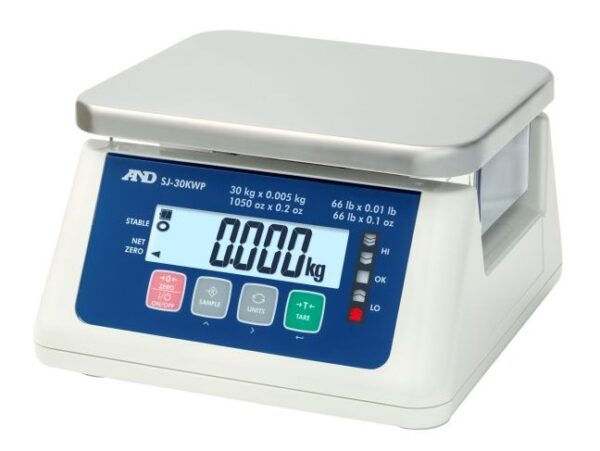
A&D SJ-15KWP cleaning and verification should preserve both its IP67 food-service construction and, when used commercially, its Class III sealed legal-for-trade configuration. The scale is built for wet environments, but good maintenance still requires compatible cleaning methods, correct battery handling, inspection for debris around the pan/load-cell shield, and known-weight verification after major cleaning or movement. On a commercial unit, CoC 18-131 protects calibration access with a physical security seal; routine users should verify performance without breaking that seal.
IP67 cleaning procedure
Remove food residue before it hardens. The removable stainless pan and waterproof SJ-WP construction support thorough washdown, and A&D’s IP67 rating provides protection against standardized temporary immersion. Use detergents compatible with stainless steel, seals and plastics, and avoid abrasive tools that can scratch surfaces or damage sealing interfaces. IP67 is not an unlimited chemical-resistance or pressure-washing specification. After cleaning, inspect beneath the pan and the transparent support/shield area for trapped debris, then allow the scale to drain/dry before verification.
Six D batteries and moisture control
The SJ-WP operates from six D cells, and A&D lists approximately 5,000 hours with alkaline batteries when backlight and comparator LEDs are off. Replace all batteries together and make sure the compartment/seal is correctly closed after service. If the scale shows low-battery warnings, slow response or erratic behavior, correct power condition before assuming calibration has changed. Remove batteries for long-term storage and inspect for corrosion if the scale has been exposed to heavy moisture or has been stored in a humid environment.
Start-of-shift zero and known-weight verification
Place the scale on a stable level surface, install the clean pan, power on and confirm zero. Apply a known test weight representative of normal use and wait for a stable reading. For legal-for-trade operation, compare the result using the certified trade interval—5 g, 0.01 lb or 0.2 oz—not the finer high-resolution display. Repeat the check after moving the scale, dropping it, overloading it, exposing it to a major temperature change or performing unusually aggressive cleaning.
Calibration versus verification on the Class III model
Verification checks the scale without changing settings. Calibration adjusts the weighing relationship. CoC 18-131 describes a plate and wire security seal over the recessed calibration button, so a commercial device can show evidence if protected calibration access is opened. If a sealed trade scale fails verification, first rule out debris, leveling, a bad check weight, temperature transition and low batteries. If adjustment is truly needed, use qualified service and follow the local resealing/inspection process rather than treating calibration as a routine operator function.
Comparator lights are wrong even though weight looks right
If the weight display is correct but the red/yellow/green comparator judgment is unexpected, check the stored lower/upper limits and the selected comparator logic before touching calibration. Make sure tare/zero state matches the procedure and that the target limits are entered in the active unit. Comparator configuration is a process-control setting; a wrong comparator result does not automatically indicate a load-cell or span problem.
Unstable readings after washdown
If the display will not settle after cleaning, check for water or product continuing to drip from the load, residue touching the pan support, a rocking surface, strong airflow and temperature differences between the scale/product and room. A cold wet scale moved into a warm room can show temporary instability until temperatures equalize. Let the scale stabilize, confirm the pan is mechanically free and verify with a known weight before deciding service is necessary.
Zero will not return
Remove all product and containers, inspect around and beneath the pan for trapped material, make sure the pan is seated correctly and confirm the scale is level. Check for a tray touching the counter or splash guard. If zero remains abnormal, power cycle only after the scale is unloaded and stable, then perform verification. Repeatedly pressing zero can hide a mechanical offset; it should not be the substitute for finding residue or damage.
Reading is consistently high or low
Confirm the correct unit and use a second known weight if available. Make sure the reference weight itself is suitable and clean. Check whether the scale is in high-resolution process mode or fixed legal mode so you interpret divisions correctly. If a consistent span error remains under controlled conditions, service/calibration may be warranted. On a sealed commercial unit, do not open protected calibration access without following the required service process.
When to remove SJ-15KWP from service
Remove the scale from critical or commercial use after repeated failed verification, severe overload/drop, visible pan/support damage, a broken required trade seal, corrosion in the battery area or any condition where water/product entered beyond intended protected areas. Mark the unit so another operator does not continue transactions, then arrange service and any required reinspection before returning it to use.
Frequently asked questions
Can SJ-15KWP be washed thoroughly? Yes, it is IP67, but follow compatible cleaning methods rather than assuming unlimited chemical/pressure exposure. What batteries does it use? Six D cells. How long can alkaline batteries last? About 5,000 hours under A&D’s stated low-power conditions. What should a trade user verify against? The certified 5 g / 0.01 lb / 0.2 oz intervals. Can an operator freely recalibrate a sealed NTEP unit? No. What commonly causes unstable readings after cleaning? Dripping product, debris, temperature transition, airflow or unstable placement. When should it be removed from commercial service? After failed verification, physical damage, a broken required seal or other conditions that call approved performance into question.
Comments