

A&D SJ-15KWP High-Resolution vs NTEP Trade Mode Explained
- pete8781
- Jul 31
- 4 min read
Need more details or help choosing the correct item? Call MNM Scales at (832) 290-3120 or email mnmscales@yahoo.com.
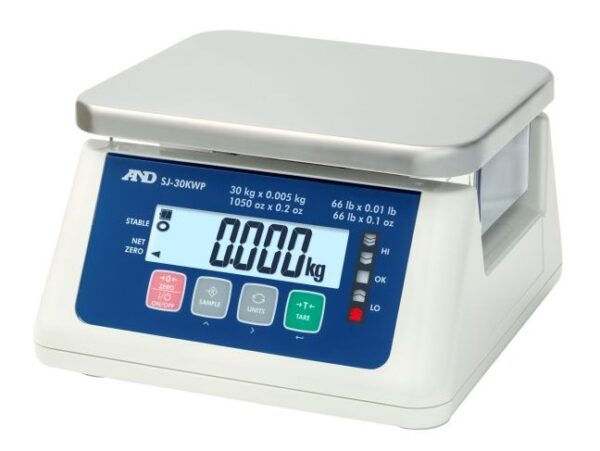
The A&D SJ-15KWP high-resolution versus NTEP question has an exact answer: the scale family supports fine process display settings, but its Class III trade mode is fixed at the larger intervals on CoC 18-131. High-resolution use can show 15 kg with a 0.0005 kg / 0.5 g minimum display and 33 lb with a 0.001 lb minimum display. The legal-for-trade SJ-15KWP configuration is 15 kg × 0.005 kg, 15,000 g × 5 g, 33 lb × 0.01 lb and 520 oz × 0.2 oz. Those two sets of numbers describe different uses, not conflicting specifications.
Why the product page shows multiple readabilities
A&D designed the ordinary SJ-WP as a high-resolution process scale with selectable display resolution. The SJ-WP manual describes low, normal, high and maximum resolution ratios and explains that the factory setting is normally a middle/high-resolution setting rather than the finest possible display. For SJ-15KWP, published high-resolution choices include 0.5, 1, 2 and 5 g in metric and 0.001, 0.002, 0.005 and 0.01 lb in pounds. A process owner can select a display appropriate to speed, stability and required resolution.
Why legal-for-trade mode is fixed
Legal metrology does not let an operator arbitrarily change the verification interval after a device has been placed in commercial service. The SJ-WP manual states that display-resolution selection is not available on legal-for-trade models; their resolution is fixed. For SJ-15KWP, the certified Class III values are those on CoC 18-131. That fixed configuration is part of what an inspector is evaluating, along with markings, sealing, zero/tare behavior and performance.
0.5 g readability does not mean 0.5 g trade accuracy
A common buying mistake is to see “0.5 g readability” and assume a customer transaction can be conducted in half-gram increments. It cannot on the Class III SJ-15KWP configuration. The certified metric division is 5 g. High-resolution display is useful for internal portion development, yield analysis and process adjustment, but trade tolerances and transaction resolution are tied to the approved configuration. More displayed digits are not the same thing as more legal metrology divisions.
Which mode for portion control?
For internal portioning—such as targeting 225.0 g of prepared food—high-resolution mode can help operators see smaller changes and reduce giveaway. Use a comparator band based on the actual process tolerance, not necessarily one display increment. If the same portion is then sold to a customer by displayed weight, the transaction should be made in the legal-for-trade configuration at the certified division. An operation can therefore legitimately use high-resolution weighing for process control and a certified mode/device for the commercial transaction.
Which mode for seafood, meat and produce sales?
Use the Class III trade configuration whenever customer price or quantity is established directly by scale weight. CoC 18-131 gives the exact SJ-15KWP values: 33 lb × 0.01 lb, 15 kg × 0.005 kg and 520 oz × 0.2 oz. Keep the required calibration seal intact and follow state/local placement-in-service rules. A finer high-resolution setting may be useful elsewhere in the facility, but it is not a substitute for the approved commercial configuration.
Resolution, stability and response speed
Finer display resolution can make normal environmental movement more visible. Air movement, vibration, a wet tray that is still draining, moving product or an unsteady bench can make the last digits fluctuate. A&D provides selectable response characteristics and multiple resolution settings so process users can trade some displayed fineness for faster, more stable operation. The best setting is the one that gives repeatable decisions in the actual workstation—not automatically the maximum number of digits.
Sealing and protected calibration
CoC 18-131 describes a Category 1 physical seal covering the recessed calibration button. A plate secured by cross-drilled fasteners accepts a wire security seal so metrologically significant adjustment cannot occur without evidence. Routine commercial users should verify zero and known weights without disturbing the seal. If adjustment is required, qualified service should follow local resealing and inspection requirements. Switching a process scale to a coarser display is not, by itself, equivalent to placing a certified sealed unit into legal service.
Bluetooth model warning
A&D separates SJ-WP-BT as the Bluetooth high-resolution branch. The U.S. manufacturer page describes SJ-WP models as dual-mode legal-for-trade/high-resolution and SJ-WP-BT as high-resolution with Bluetooth connectivity. If data transmission is required at a commercial transaction point, confirm the specific approved system instead of assuming the Bluetooth version carries the same legal status as the non-BT trade configuration.
Frequently asked questions
What is the finest SJ-15KWP process readability? 0.5 g / 0.001 lb. What is the NTEP trade readability? 5 g / 0.01 lb and 0.2 oz. Are both specifications valid? Yes, because they refer to different operating configurations. Can a legal-for-trade user select arbitrary resolution? No; A&D states legal-for-trade resolution is fixed. Does more displayed resolution mean better certified accuracy? No. Which mode should be used for sale by weight? The sealed Class III configuration on CoC 18-131. Is SJ-WP-BT automatically the same NTEP configuration? No; A&D presents the BT branch as high-resolution Bluetooth rather than the dual-mode legal-for-trade SJ-WP model.
Comments