

A&D SJ-6000WP NTEP vs High-Resolution Modes: Readability & Trade Use
- pete8781
- Jul 31
- 3 min read
Need more details or help choosing the correct item? Call MNM Scales at (832) 290-3120 or email mnmscales@yahoo.com.
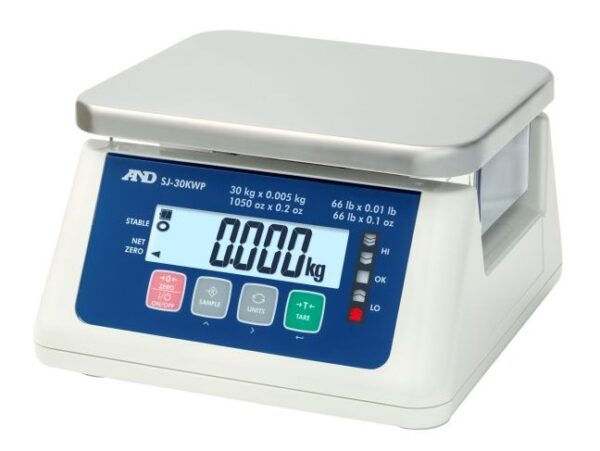
The A&D SJ-6000WP NTEP versus high-resolution specification is straightforward once the two operating purposes are separated. High-resolution process mode can display as finely as 0.2 g or 0.0005 lb. The Class III legal-for-trade configuration on CoC 18-131 is fixed at 6 kg × 0.002 kg, 13.2 lb × 0.005 lb and 210 oz × 0.1 oz. Both sets of numbers are legitimate; they simply answer different questions. The finer setting helps internal process control, while the certified interval governs commercial sale-by-weight use.
High-resolution selectable settings
A&D’s SJ-WP manual provides multiple display-resolution ratios for process models. For SJ-6000WP, published choices include 0.2, 0.5, 1 and 2 g, plus 0.0005, 0.001, 0.002 and 0.005 lb. A finer setting lets an operator see smaller changes, but it can also make vibration, airflow, dripping product and temperature effects more visible. Choose the resolution that produces reliable decisions in the real workstation instead of assuming the maximum digits are always best.
Fixed Class III trade intervals
CoC 18-131 lists SJ-6000WP at 6000 g × 2 g, 6 kg × 0.002 kg, 13.2 lb × 0.005 lb and 210 oz × 0.1 oz. Legal-for-trade resolution is fixed and protected from ordinary user changes. These are the values to use in purchasing/compliance documentation, inspection discussions and sale-by-weight operation. The high-resolution 0.2 g value should never be described as the NTEP e/d interval.
Why legal resolution is coarser
Legal metrology balances usable capacity, device class, verification divisions, environmental performance, sealing and repeatability rather than simply maximizing displayed decimals. A 2 g Class III interval at 6 kg capacity is part of the certified design. Showing 0.2 g internally does not mean a customer transaction is more legally accurate in 0.2 g increments. Certification and display fineness are separate concepts.
Use high-resolution mode for process optimization
Internal portion control, recipe development, trim/yield analysis and production checkweighing often benefit from the finer display. An operator may use 0.2 g or 0.0005 lb visibility to reduce giveaway and tune a process. The comparator can provide rapid visual feedback. If the product is later sold by weight, the transaction should occur using the correct certified configuration and approved division rather than carrying over the internal high-resolution process reading as the sale value.
Use legal-for-trade mode for commercial transactions
When customer price or quantity is established directly from the scale, use the sealed Class III configuration, correct unit and approved interval, and follow local placement-in-service/inspection rules. Routine users can zero/tare and verify known weights, but protected calibration settings should not be opened casually. The certificate’s sealing arrangement exists so a regulator/service technician can tell whether metrologically significant adjustment has occurred.
Bluetooth model distinction
A&D’s U.S. product information separates SJ-WP-BT as a Bluetooth high-resolution branch from the standard SJ-WP dual-mode legal-for-trade/high-resolution models. Do not assume a Bluetooth suffix automatically carries the same NTEP status/configuration. If wireless data is required in a regulated transaction workflow, confirm the exact approved device/system rather than generalizing from the non-BT certificate.
Verification should match the active mode
In high-resolution process use, verify against your internal tolerance and known weights. In legal-for-trade use, evaluate the scale against the certified interval and applicable service tolerances. A 1 g difference may look large on a 0.2 g process display but is still less than one 2 g trade division. Knowing which mode and tolerance applies prevents operators from overreacting to harmless high-resolution movement or underreacting to a true trade error.
Frequently asked questions
What is the finest SJ-6000WP process display? 0.2 g / 0.0005 lb. What is the Class III trade division? 2 g / 0.005 lb / 0.1 oz. Can a commercial transaction use the 0.2 g setting? No; use the fixed certified configuration. Does more displayed resolution mean more legal accuracy? No. Can an operator change legal-for-trade resolution? No; it is fixed/protected. Is SJ-WP-BT automatically the same certified configuration? No; A&D presents the BT models as the Bluetooth high-resolution branch.
Comments