
(832) 766-5410
(281) 656-2666
(832) 290-3120
All Scales USA · Cypress, TX · Industrial scales & Houston calibration

Analytical Balances
Compare analytical and semi-micro balances for laboratory sample preparation and quality control. Match the sample and container weight to capacity, then compare 0.1 mg or finer readability, calibration method and draft-shield clearance. Check repeatability and your method’s minimum sample weight for the intended measurement. Use the guide below to compare benchtop balances and production weighing modules.


Choosing an analytical balance for your workflow
Start with the smallest quantity you need to weigh and the combined weight of the sample and its container. Taring a flask clears the display; it does not create extra weighing capacity. This selection includes analytical balances, semi-micro instruments and related precision equipment, so compare each model's specifications rather than relying on the category name alone.
Compare capacity, readability and repeatability
The A&D GH-200 combines 220 g capacity with 0.1 mg readability and 0.1 mg repeatability. The A&D GR-200 offers 210 g capacity at the same readability and repeatability, with an 85 mm pan rather than the GH-200's 90 mm pan. Check that your vessel fits inside the chamber as well as on the pan.
For a heavier vessel, the A&D HR-300i reaches 320 g with 0.1 mg readability, but its specified repeatability is 0.2 mg. Readability is the displayed increment; repeatability describes variation between repeated weighings. A finer display alone does not establish the smallest sample your procedure can accept.
Know when the fine range applies
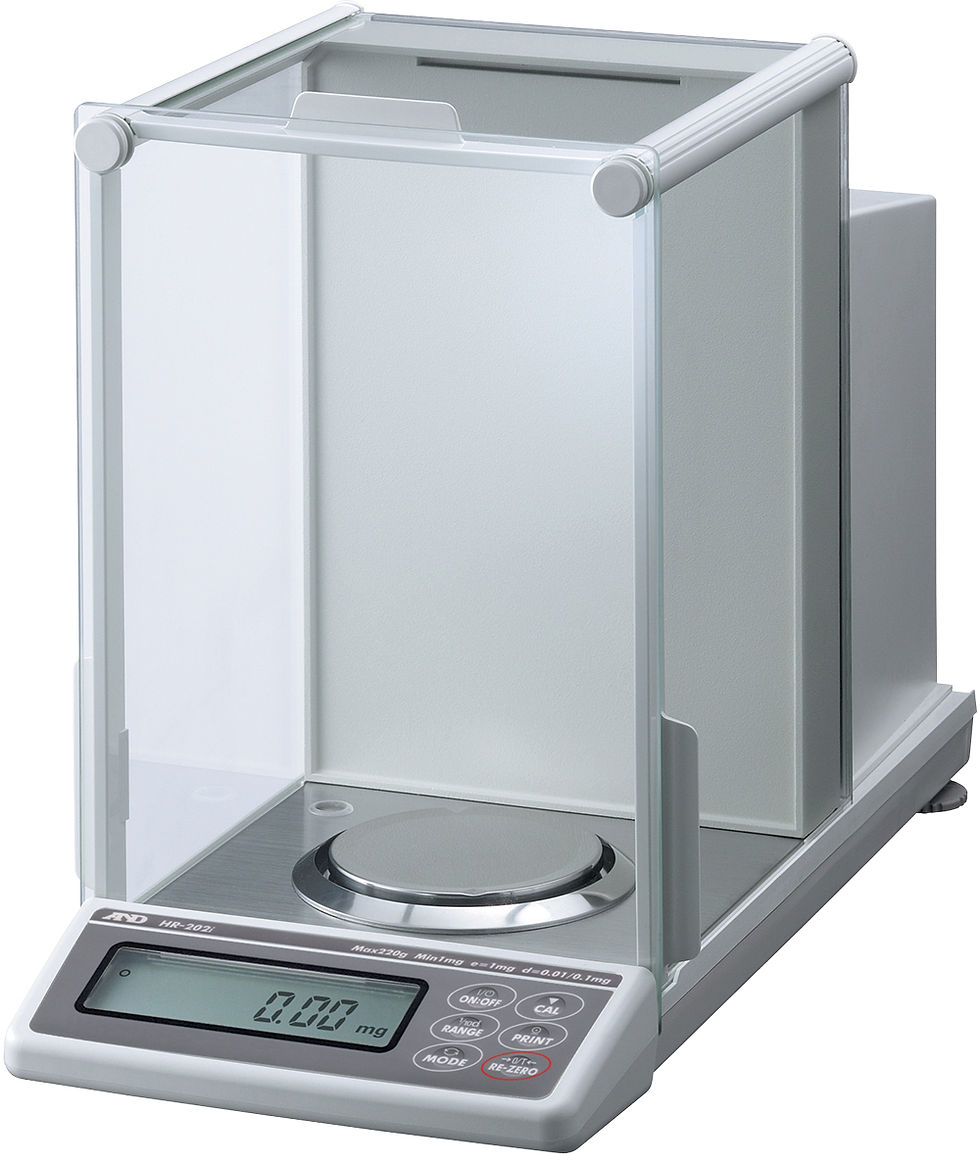
The A&D HR-202i provides 51 g at 0.01 mg and 220 g at 0.1 mg. Its fine-range repeatability is 0.02 mg. Allow for slower settling: A&D specifies approximately eight seconds in the fine range versus 3.5 seconds in the standard range under its stated test conditions. Follow the manual's range and tare instructions when planning sample additions.
Plan calibration and the weighing environment
GH-200 and GR-200 include internal calibration. HR-300i and HR-202i require external weights. Choose calibration weights by the instrument's specified mass and your required tolerance and documentation; a matching gram value alone is insufficient.
GH, GR and HR-i models have antistatic glass draft protection. Place the balance on a firm, level bench away from air outlets and vibration, and let samples reach room temperature. The HR-i manual calls for at least one hour of warm-up and a fine-range breeze-break ring for HR-202i measurements at 0.01 mg. A draft shield does not remove every source of weighing error.
Benchtop balance or integrated weigh module?
The A&D AD-4212B-101 is a production module with a separate sensor and display, a 34 mm pan and smart ranges of 31 g at 0.01 mg and 110 g at 0.1 mg. Check mounting, draft control and data connections for the planned installation.
If your method permits coarser increments or needs greater capacity, compare precision balances. Browse the wider lab and analytical selection or other A&D weighing equipment to match the instrument to the task.
Need help choosing?
Call (832) 766-5410 or email All Scales USA with your sample and vessel weights, required readability and calibration procedure. Include whether the balance will sit on a laboratory bench or connect to production equipment.